Author: Racheal Fest
-
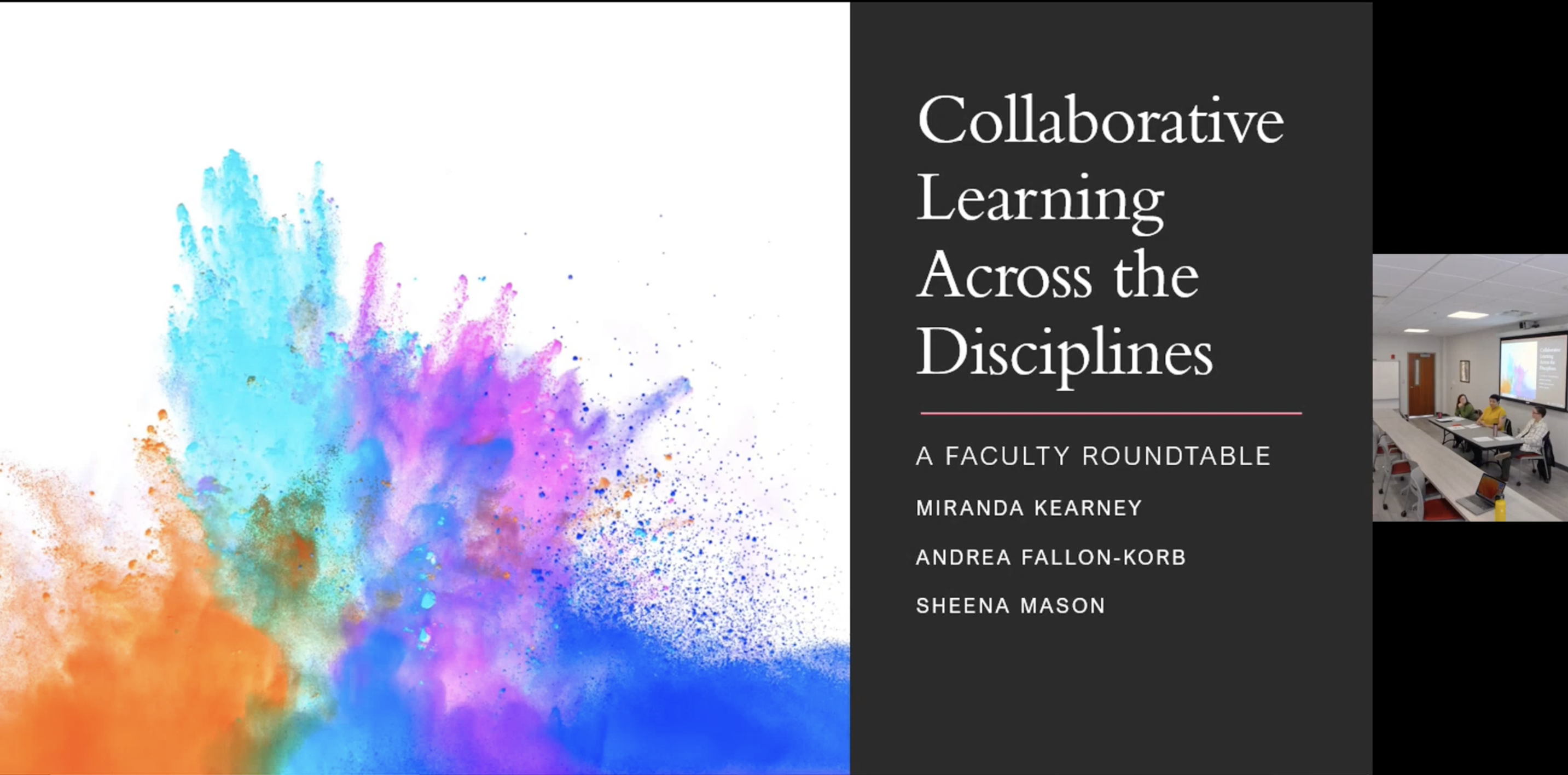
Collaborative Learning Across the Disciplines: A Faculty Roundtable
This past semester, the TLTC convened a faculty roundtable to share strategies related to collaborative learning. After experiencing online and asynchronous learning environments over the past several years, students may need additional support learning to work together and to build community in the classroom. To promote cooperative and interactive learning, we can take purposeful approaches,…
Written by
-
Resources from Our Professional Learning Community on Teaching Interculturally
Last week, the Faculty Center and the Teaching, Learning & Technology Center wrapped up our spring professional learning community, with a focus on intercultural pedagogy. Faculty and staff from Access and Opportunity Programs, Business, Global Education, Sport and Exercise Science, and more came together every other week to talk about Teaching Interculturally: A Framework for…
Written by
-
Scaffolding for student success
Discussion, as a whole class and in small groups, has always been a vital part of my classroom practice. Sometimes, though, when I pose a question to get things started, students don’t answer right away. Maybe we’re trying to identify unspoken assumptions so that we can evaluate them: “why do people go to college?” Maybe…
Written by

-
Backward design: Keeping goals in view
Since education policy leaders Grant Wiggins and Jay McTighe published Understanding by Design in 1998, backward design has dominated conversations about best practices in curriculum planning, both in US schools and in higher education. Simply put, backward design encourages you to begin your course prep at the end, by first identifying what you want students…
Written by
-
Building in formative assessment
In the wake of high-stakes testing culture, education researchers have come to promote assessment practices that emphasize formative evaluation. Unlike a summative assessment, which measures student performance at the end of a course or a unit, a formative assessment helps you and your students take stock of achievements in the midst of instruction. Rather than…
Written by

-
Engaging students: Collaboration in the classroom
After years of remote and hybrid instruction, students are both excited to work with others and nervous about how to. Faculty can help students find supported paths to making connections in the classroom. Collaborative learning encourages students get to know each other, gives them a chance to grapple with unfamiliar insights or viewpoints, and can…
Written by

-
Revitalizing your teaching philosophy with new practices
Statements of teaching philosophy have long been standard documents for academic employment and promotion dossiers. These statements explain in a page or two how and why we teach. (Guides on how to write a good one proliferate—the University of Michigan’s Center for Research on Learning and Teaching links many of them here). In addition to…
Written by

-
Introducing Teaching Foundations: A Series on Pedagogy
Collaboration, Inclusive & Global Learning, Project Based Learning, Student Engagement, Universal DesignWelcome to Teaching Foundations, a new content series devoted to sharing pedagogy resources responsive to our moment with teaching faculty at SUNY Oneonta. I’m Racheal Fest, and I’m excited to join our campus community this semester, supporting faculty pedagogy in the Teaching, Learning, and Technology Center. I bring a background in critical pedagogy, student success…
Written by